Cyber security managed services are usually priced per user or per endpoint per month, and the spread between two quotes for the same organization is routinely two to three times. The difference is almost never margin. It is scope, and specifically whether anyone is being paid to be awake outside business hours.
Before comparing prices, get every provider to quote against the same written list. Otherwise you are comparing a monitoring subscription against a staffed service and concluding that one of them is expensive.
Why the quotes diverge so far
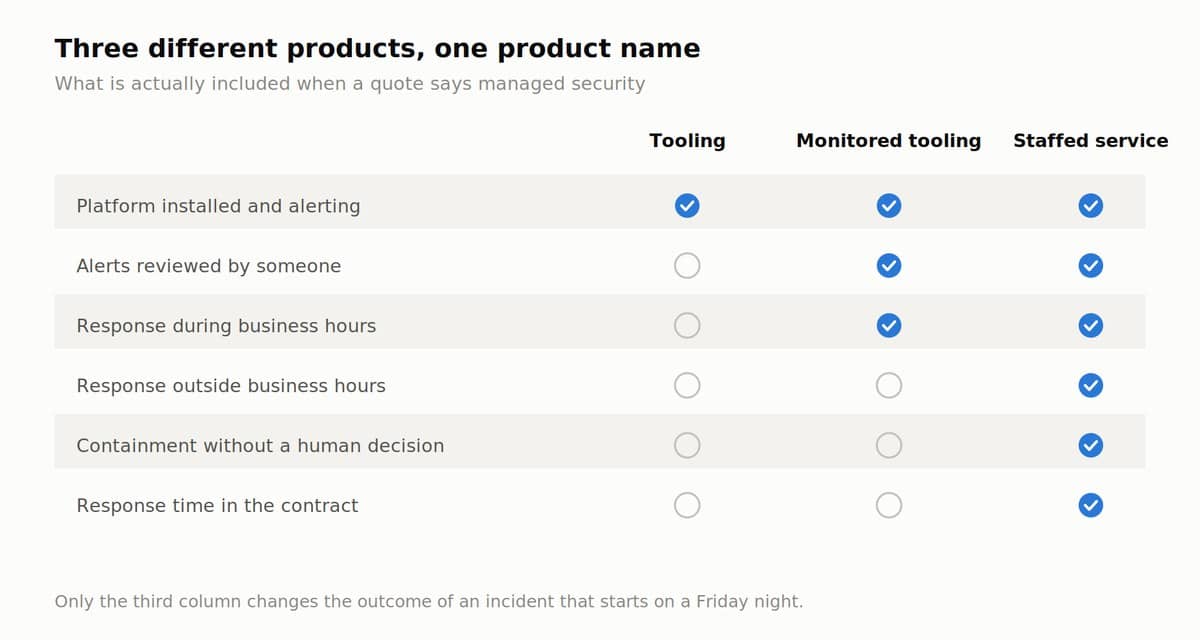
Three products get sold under the same name.
The first is tooling. A platform is installed, it generates alerts, and the alerts go to your own staff. This is the cheapest line on any comparison sheet and it is a software purchase with a service label.
The second is monitored tooling. Someone reviews the alerts, usually during business hours, usually with a queue behind them. Response arrives the next morning.
The third is a staffed service with a named response commitment, automated containment, and a person reachable at 3 a.m. who can isolate a machine without waiting for your approval.
All three are defensible purchases for different organizations. Only the third does anything about an incident that starts on a Friday night, which is when they tend to start.
What actually drives the number
| Cost driver | Why it moves the price | What to ask |
|---|---|---|
| Coverage hours | Staffing nights and weekends is the single largest input | Is it 24/7, and staffed by whom |
| Named response commitment | A contractual response time requires capacity in reserve | What is the number for a critical incident |
| Automated containment | Isolation without a human decision needs platform licensing and rules work | Can it quarantine an endpoint on its own |
| Onboarding depth | Inventory, documentation, patch remediation and backup verification in the first 60 days | Is this included or a separate project |
| Compliance reporting | Evidence packs for auditors, insurers and enterprise clients | Which frameworks, and how often |
| Endpoint and user count | The billing unit; watch which one is used | Per user or per device, and what counts |
That last row causes more surprises than any other. Per-user pricing and per-device pricing produce very different totals in an organization where staff carry a laptop, a phone and a desk machine. Ask for the total, not the rate.
The market context worth knowing before you negotiate
Providers are quoting into a market where buyers have become considerably better informed, which works in your favour.
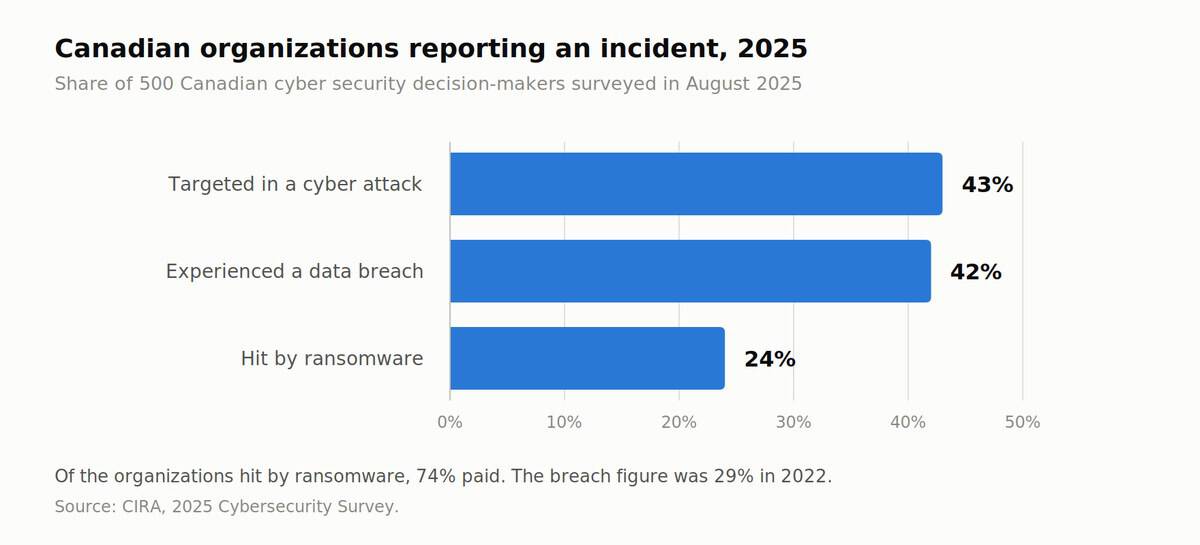
The 2025 CIRA Cybersecurity Survey, based on 500 Canadian cyber security decision-makers surveyed in August 2025, found 43% of organizations had been targeted in an attack and 42% had experienced a data breach, up sharply from 29% in 2022. Ransomware hit 24%, and of those, 74% paid. Meanwhile 78% had increased their IT and security budgets by between 10% and 25%.
Two things follow. Budgets are moving, so providers expect to compete. And the breach rate has risen far enough that “it has not happened to us” has stopped being evidence of anything.
For fraud specifically, the Canadian Anti-Fraud Centre, operated by the RCMP with the Ontario Provincial Police and the Competition Bureau, publishes running national figures and is the place to report an incident. Business email compromise remains the category that costs organizations the most and involves no malware at all, which is why email controls belong in the quote even when the conversation is about ransomware.
What a complete quote contains
Ask for these as line items rather than a bundled monthly figure. A provider who will not itemize is telling you something.
- Monitoring scope: which endpoints, which cloud tenants, which network devices
- Coverage window and where the analysts sit
- Critical-incident response commitment, stated in minutes or hours
- Automated containment: what the platform may do without asking
- Patch management: cadence, and who signs off on reboots
- Backup: whether it is included, whether it is immutable, and who tests restores
- Email security and phishing simulation
- Reporting: what arrives monthly, and whether it is readable by a non-technical board
- Onboarding: the first 60 days, itemized
- Exit terms: how you get documentation and credentials back
An organization comparing managed security services in Alberta against a national or offshore option will usually find the regional providers itemize more willingly, because their differentiator is the staffing model rather than the price.
Where to spend first if the budget will not stretch
Sequence beats coverage when money is tight.
Authentication comes first, and it is close to free relative to its effect. Phishing-resistant multi-factor authentication on email, remote access, administrative accounts and the backup console closes the pathway behind the majority of intrusions.
Backup integrity comes second. Immutable or separately authenticated storage, plus one documented restore test with a date on it.
Monitoring comes third. It is the most expensive line and the least useful if the first two are missing, because detection without recovery just tells you the bad news earlier.
A note on the cheapest quote
The lowest number on a comparison sheet is usually a tooling subscription competing against staffed services. It is not a bad product. It is simply answering a different question, and organizations that buy it thinking they have bought coverage discover the distinction at the worst possible moment.
Put all three products in separate columns, then decide which question you are actually paying to answer.