
TL;DR
- A quote far below the others is not a bargain, it is a different scope. Ask what is outside the fee before you ask what is in it.
- The person selling to you is rarely the person doing your work. Ask who prepares the file and who reviews it.
- In many countries the word accountant is not protected. Ask for the body and the membership number, then actually check it.
- If you trade in another country, your domestic accountant has no standing there. That gap is where owners get caught.
Short version: the meeting is your whole due diligence, and it rarely runs past an hour. Six questions decide whether the next three years are quiet or expensive.
Hiring an accountant is one of the few purchases where you cannot inspect the goods. You hand over your records, and a year later you find out whether the person you chose was any good. By then, switching is a project.
The interview is therefore the whole of your due diligence. Here is what to ask, and what a good answer sounds like.

First, what should this cost
Price is the question everyone opens with and the one that tells you least on its own.
A sole trader with straightforward affairs might pay a few hundred pounds a year for a return and little else. A small limited company with payroll, VAT and year end accounts is usually on a monthly retainer. Outsourced finance functions, where somebody else runs the whole ledger rather than just filing at the end, are priced per month and scale with transaction volume rather than with revenue.
Two rules hold across all of them. A quote that is far below the others is not a bargain, it is a different scope. And an hourly rate for recurring compliance work is an invitation to a surprise, because compliance work recurs whether or not you thought about it.
“What exactly is in the fee?”
Ask for the list. Bookkeeping, VAT returns, payroll runs, year end accounts, the corporation tax return, the confirmation statement, dealing with the tax office on your behalf.
Then ask what is outside it. Most practices charge separately for anything unusual, which is reasonable, but you want to know now rather than in an invoice. Registering for a new tax, a director’s personal return, a mortgage reference letter and any correspondence about an enquiry are the usual extras.
A firm that answers this in one sentence has not understood the question. A firm that sends you a scoped list has done this before.
“Who actually does my work?”
The person selling to you is frequently not the person doing the work. That is normal and it is not a problem, provided you know it going in.
Find out who prepares your file, who reviews it, and who you email when something breaks at four in the afternoon. If the answer is a shared inbox, ask what the response time commitment is. If the answer is one named individual, ask what happens when that person is on holiday in the week your return is due.
“What software, and can I take my data out?”
Your accounting records are yours. In practice they live in a system chosen by your accountant, and how easily you can leave with them varies enormously.
Ask which platform they use, whether you get your own login rather than a screenshot when you want to see something, and what an export looks like if you move. A practice that resists giving you direct access to your own ledger is telling you something about the next conversation you will have with them.
“What happens if something is filed wrong?”
Deadlines in most jurisdictions are hard, and the penalties are automatic. In the UK, for instance, Self Assessment returns and payments run to fixed dates, and Companies House applies its own separate calendar for accounts and confirmation statements. Two sets of deadlines, two sets of consequences, one accountant.
So ask directly. Who carries the penalty if a filing is late because it sat on their desk? Is there professional indemnity insurance, and at what level? The answer matters less than the willingness to answer it plainly.
“Who regulates you?”
In many countries the word accountant is not protected, and anyone can use it. Membership of a professional body brings a complaints route, a code of conduct and mandatory insurance. Non membership is not automatically disqualifying, but it does mean your only recourse is a court.
Ask which body, ask for the membership number, and check it. It takes two minutes and almost nobody does it.
If the company trades in another country
This is where most owners get caught out. A practice that is excellent at your domestic filings usually has no standing at all in a foreign tax administration, and a subsidiary or a branch abroad generates local obligations that do not pause while you find someone.
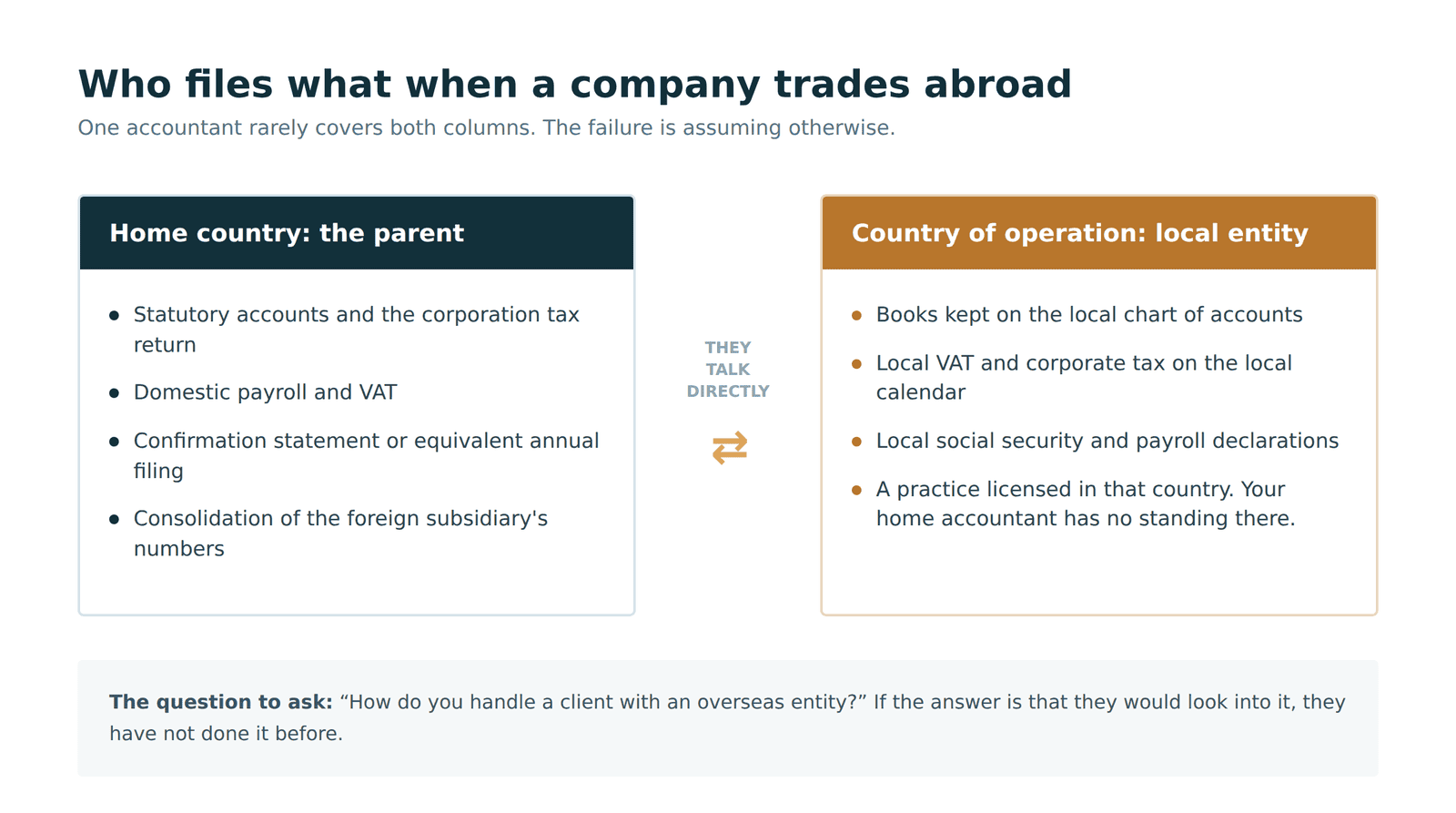
The pattern that works is a domestic accountant for the parent and a licensed local practice for each country you actually operate in, with the two talking to each other directly rather than through you. In Morocco, for example, a local chart of accounts applies, VAT and corporate tax declarations follow a domestic calendar, and payroll runs through the national social security scheme, so the work has to be done by someone registered there. Firms like LetsPro Comptable Tanger publish a monthly fee range openly, which is a useful habit to look for wherever you are hiring, because a practice comfortable naming its price before it has seen your books is a practice that has scoped this kind of work many times.
Ask any candidate how they handle a client with an overseas entity. If the answer is that they would look into it, they have not done it.
Signs to take seriously in the first meeting
- They quote before asking about your transaction volume
- They cannot say who would do the work
- They describe a deadline as flexible
- They want your records but will not give you access to the system holding them
- They answer the regulation question with a brand name rather than a body and a number
None of these are fatal on their own. Two of them together usually means you are the wrong size of client for that practice, which is worth finding out in the meeting rather than in month seven.
One last thing worth doing
Ask for the contact details of a client of roughly your size and complexity, then actually make the call. Ask that person one question: what happened the last time something went wrong.
The answer to that tells you more than the fee schedule ever will.